
LinkedIn wants us to spot AI slop. But can we?
Fast answer: Not easily. Research consistently shows people are barely better than chance at identifying AI-generated content from style alone. But ...

Fast answer: Not easily. Research consistently shows people are barely better than chance at identifying AI-generated content from style alone. But it’s not quite as straightforward as that; if we treat the grammar tics we usually associate with AI as a red herring, what really makes ‘AI slop’ obvious is the absence of a genuine, original point of view.
You might have noticed a new addition to your LinkedIn feed, as a few weeks ago the B2B community’s favourite social media platform added a button that allows you to flag a post that ‘Seems like AI slop.’ One quick click, and the content vanishes from your feed, while a signal gets sent to LinkedIn's detection models.
At a time when trust in social content is tenuous at best, the need for cleaner, more trustworthy feeds is strongly felt. Our recent LinkedIn poll, where we asked what users think of the platform’s latest feature, shows that users welcome tools that could help them report generic, low-quality content that was most likely to be entirely AI-generated.
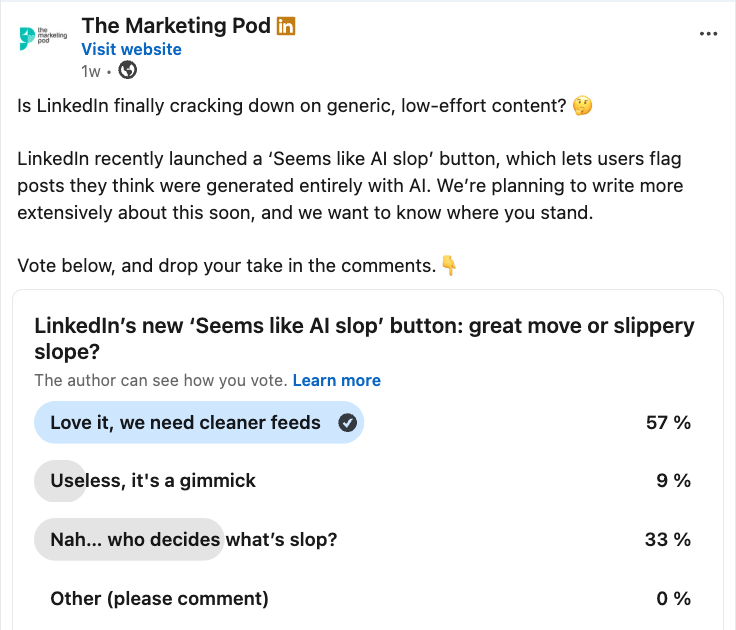
There's just one problem: research tells us we’re really, really bad at spotting it.
Having spent over a decade in both academic and commercial B2B writing, I have built a large LinkedIn network of professional writers, editors, journalists, proofreaders and academics. So believe me when I say I’m more than familiar with the heated debate on ‘AI identifiers’. It goes like this:
On one hand you have those who believe they’ve cracked the code and present us with simple lists of what should help us identify whether content has been entirely AI-generated: “It’s not X, it’s Y”; “here’s what no one tells you”; the rhetorical question followed an answer; and, most infamously of all, the poor em dash.
On the opposing side are those fiercely defending these supposed AI tells, on very valid grounds – they’ve been using them for decades. So, who’s right? The second group is right, for the simple reason that AI learned language from us, not the other way around. It’s no surprise its writing echoes the writing patterns we’ve been using for decades.
The research backs this up. A 2023 study found that even linguistics professors struggle to distinguish between human and AI-generated writing, getting it right only 38.9% of the time – worse than a coin toss.
If some of the world’s most highly trained linguistic experts cannot reliably distinguish human- from AI-generated content, what chances have we got? And yet, if the telltales of AI writing aren’t so obvious after all, how come many of us sometimes just know when content is entirely AI-generated? What is that elusive element that makes us say, without doubt, that no human was involved?
Perhaps the answer isn’t in the syntax of a sentence or in stylistic choices like using em dashes or tripartite lists, but in something more substantial. Perhaps it’s not in something that is present, but in something that is lacking.
When our senses start tingling and we realise that something is missing from the content we’re looking at, it’s usually because of the absence of a genuine and distinctive point of view. This is the ‘thought leadership’ that’s so sought after in B2B marketing, and with good reason. Real thought leadership doesn’t come from a string of perfectly formed, typo-free sentences, but from expressing the specific and original point of view that only one person could express, which has lived in their brain and nowhere else until they decided to put pen to paper.
AI can simulate a genuine insight by drawing from knowledge that’s already online and expressing it according to the parameters it’s been given. It can even be trained to stick to a specific style and tone of voice, and thus achieve a semblance of originality. What it cannot replicate is the actual experience of interacting with a real thought leader.
And on LinkedIn specifically, we have something no detector or checklist has: familiarity. If we've been reading a person's posts for years, we know their opinions, their style and the things that make them unmistakably them. So, when a post suddenly reads like everyone else's, that’s not a grammatical or syntactical clue we’re sensing: it’s a relational one. We’re not detecting AI per se, but the lack of the person we know. And for a genuine thought leader with hundreds or thousands of loyal followers, that’s a big deal.
No one wants to give their time and attention to low-effort, generic content that has been created without meaningful human involvement, whether AI has been used to write it or not. That distinction is important. A LinkedIn post could be entirely created by human hands and still be utter slop. On the flipside, a post that has been created with help from AI can still provide insight and/or entertainment, if a genuine, human point of view sits behind it.
Slop detention isn’t a grammar issue, it’s a trust issue. So, next time you’re about to click the ‘Seems like AI slop” button, think again: what makes it sloppy? Is it truly just the em dash, or is it valuable, fresh insights you’re missing? Asking this will not only support the circulation of genuine thought leadership, but also contribute to training LinkedIn’s algorithm to protect the one thing that no list can encompass: true human intelligence.
If you’d love some support expressing your uniquely brilliant thoughts in a way that’s both personable and grammatically correct, get in touch with our content team.

Need words? You've come to the right place. Our PR and Content Writer Monia has a true love for writing and all the well honed skills you need to effectively position your brand. Plus – she speaks no fewer than four languages, so will never be lost for words.










.png)




 Mike Nicholls
 Alexander Costello